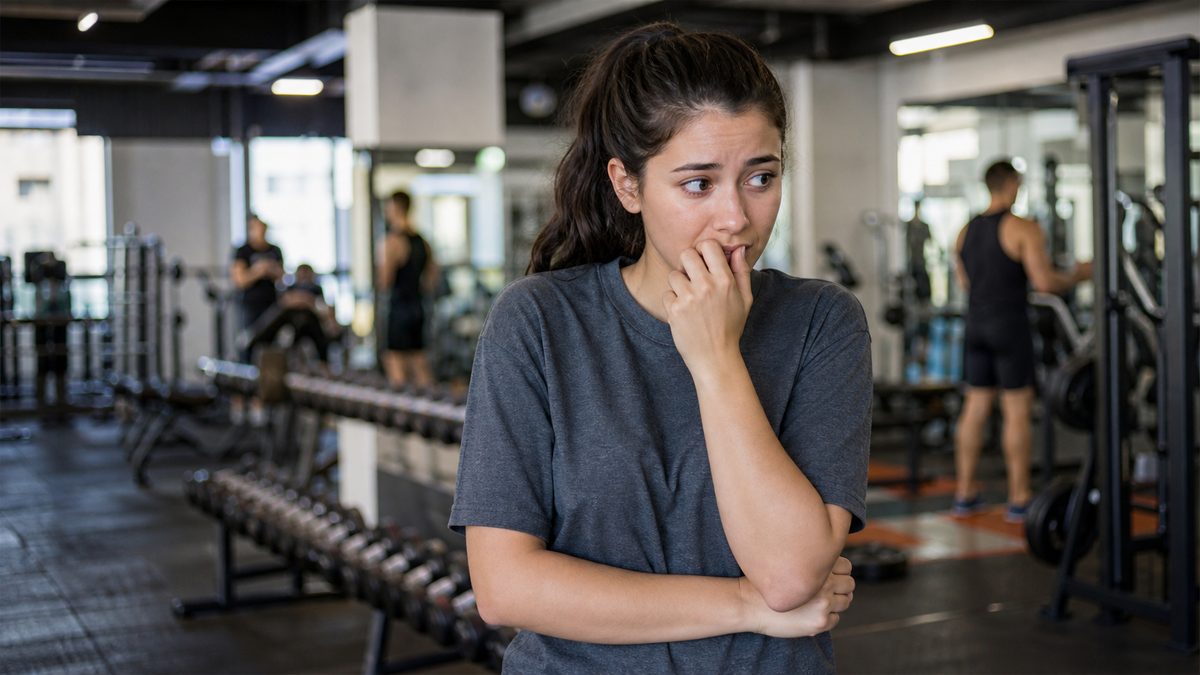
Start with a short, simple gym visit that you can finish even while you feel anxious. You don't have to feel confident before walking through the door. Confidence comes later, once your brain sees that you can enter, train, and leave safely.
Gym anxiety often sets a false entry rule: you must know what you're doing, look fit, and feel calm before you belong. That rule leaves people stuck outside. Try a smaller first goal. Get used to the room, then work on exercise quality once the place no longer feels so new.
Why does the gym make you feel so exposed?
A gym puts your body, movement, and skill on show in a shared space. That can trigger Self-consciousness, especially when you're new to exercise or unhappy with your Body image. Mirrors may make it worse.
So can tight clothing, strange machines, and the feeling that everyone else knows some hidden set of rules.
Social anxiety adds another layer. You may expect people to judge your weight, technique, strength, or fitness. Even a normal glance can seem like proof that someone is watching, so your mind writes a harsh story without enough facts.
Most gym users are busy with their own workout. They're counting repetitions, checking equipment, changing music, or racing to finish before work. Some will notice you because people notice movement nearby. Noticing isn't the same as judging.
Fear can still cause a real physical response. Your Heart rate may rise before you've exercised. Your hands might sweat, your muscles may tighten, and you may want to leave.
These signs mean your threat system has switched on. They don't mean the gym is unsafe or that you're failing.
Should you wait until you feel more confident?
No. Waiting teaches your brain that anxiety must vanish before you can act. That can make the next gym visit feel even harder.
Anticipatory anxiety is the distress that shows up before an event. It might begin the night before a planned workout. You picture getting lost, using a machine the wrong way, or being unable to finish.
By the time the session starts, you're tired from an event that hasn't even happened.
A useful response is to take one small action while the anxiety is still there. Psychologists call this Behavioral activation. You choose a helpful behaviour first instead of waiting for motivation or a better mood.
Your first visit, for example, could be ten minutes on a walking machine followed by one easy exercise. It may seem too small to count. It counts. That short session starts breaking the link between anxiety and avoidance.
In my experience, people who settle into a gym routine fastest don't begin with brutal workouts. They repeat manageable visits. Every finished visit gives the brain fresh evidence: I arrived, handled the discomfort, and did what I planned.
What should your first few visits look like?
Keep your first visits predictable. Choose when you'll arrive, where you'll start, and how long you'll stay. Put the plan on your phone so you aren't making choices while anxious.
A useful first session can look like this:
- Enter and put your belongings away.
- Walk or cycle at an easy pace for five minutes.
- Complete two familiar exercises for one or two sets.
- Leave after 15 to 20 minutes, even if you feel able to do more.
Leaving at the planned time matters. It shows that you control the dose. This session isn't a test of how much discomfort you can bear.
Follow the same route and exercise order for several visits. Familiarity cuts the mental load. When the session starts feeling routine, add one exercise or a few minutes. Don't change the whole plan at once.
One of my clients used to sit in her car for 20 minutes before entering the gym. Her first goal wasn't a full workout. She walked in, used one bike near the door, and left after eight minutes.
After several visits, she stopped waiting in the car. Fitness wasn't the key change. The building had become familiar.
How can you train without worrying that you look inexperienced?
Pick exercises that are easy to set up and simple to stop. A treadmill, stationary bike, cable row, leg press, or light dumbbell movement may feel less daunting than a packed free-weight area. The best starting exercise is one you can control while noticing your breathing and body position.
Read the diagram on the machine before starting. Choose a light load and do a few slow repetitions. If the movement feels wrong, stop. Changing a seat or lowering the weight is normal gym behaviour.
You could also ask a staff member one specific question, such as, “Can you show me how to adjust this seat?” That often feels easier than asking for a full workout lesson. And you get the exact help you need.
Don't try to prove you belong by lifting too much. Heavy, rushed repetitions add strain and make a new exercise tougher to learn. Skilled gym users change loads, rest when they need to, and check their setup.
What should you do when anxiety rises during a workout?
Don't wrestle with every anxious thought. Pull your focus back to the next physical action. Plant your feet. Hold the handle. Breathe out during the effort. Count the repetition.
If your Heart rate rises, check what's driving it. Exercise should raise it, and anxiety can raise it too. Slow down for a minute, then see if you can speak a full sentence.
If you have chest pain, feel faint, or have symptoms that seem medically unsafe, stop and seek suitable medical help.
Use a brief reset when you feel watched:
- Look at one fixed object rather than scanning the room.
- Relax your jaw and lower your shoulders.
- Breathe out longer than you breathe in.
- Complete the next planned set, then reassess.
You aren't trying to force anxiety down to zero. Stay long enough to learn that the feeling can rise and fall without running your actions.
How do you stop comparing your body with other people?
Treat comparison as shaky information. You can see another person's body or the weight they're lifting. You can't see their training history, health, schedule, injuries, or starting point.
Body image can turn a mirror into a scorecard. Use mirrors to check technique, not to inspect yourself. See whether your knees track well or your back stays steady, then look back at a neutral point.
Wear clothes that let you move without constant tugging and adjusting. You don't need an outfit that looks like social media gym wear. Pick fabric and coverage that help you pay attention to training.
Changes in Muscle tone take time. A short-lived muscle pump, lighting, posture, and hydration can all alter how your body looks that day. Appearance is a poor score for one workout.
Track what you can control instead: visits finished, exercises learned, and loads used with sound form.
How hard should you train at the start?
Finish most early sets with several good repetitions still in you. You should feel like you've worked, but still be able to repeat the session later that week. Severe soreness can make the next visit feel like another threat.
Progressive overload means raising the training demand over time. It doesn't mean adding weight at every session. You could do one more repetition, move through a better range, use cleaner technique, or add a little weight once the current load feels steady.
Write down each exercise, load, and repetition count. This cuts guesswork and makes your progress easy to see. A written log also shifts your focus away from how you looked and onto what you did.
What I found was that anxious beginners often rate a session by discomfort. If it felt awkward, they call it a bad workout. A fairer measure is whether the plan suited their current ability and moved them one step ahead.
How does confidence actually grow?
Confidence grows from proof. Self-efficacy is the belief that you can carry out a certain action. It gets stronger each time you finish a task that once felt hard.
Build that proof step by step. First, enter the gym. Next, finish a short routine without rushing. Later, learn a new machine or train at a slightly busier time.
Each step should stretch you a little without flooding you.
Don't brush off small wins. Walking in while nervous is a win. Asking for help is a win. Lowering a weight to keep good form is a win. Those choices show skill and control.
A training partner may help if they respect your pace. Ask them to stick to the written plan instead of turning the visit into a surprise workout. Their support should make things clearer, not push you to perform.
A personal trainer may also cut uncertainty by setting up equipment, choosing suitable exercises, and giving you a clear starting point. Tell them plainly that you feel self-conscious. Ask for a quiet area, simple directions, and warning before any change.
You're still allowed to pause or turn down an exercise.
What mistakes keep gym anxiety going?
The first mistake is making the opening workout too big. A 75-minute plan packed with unfamiliar exercises gives you more chances to feel lost. Start below your maximum ability so you can come back and repeat the visit.
The second is leaving as soon as discomfort arrives. Escape brings quick relief, which teaches your brain to flee even sooner next time. If you're physically safe, finish one small planned action before going. That could be one minute of walking or one easy set.
The third is hiding behind your phone for most of the session. Music or written notes can help, but endless scrolling cuts you off from the room. Use your phone as a tool, then get back to the plan.
The fourth is expecting anxiety to drop in a neat, straight line. One visit may feel easy, while the next feels tense. Sleep, stress, crowd size, and a new exercise can all change your response. Measure progress over several weeks.
When does gym anxiety need more support?
Get extra support if anxiety causes repeated panic, keeps you out of many public places, or controls large parts of your week. A psychologist or another qualified mental health professional can help with patterns tied to Social anxiety, panic, trauma, or severe Body image distress.
Exercise may support wellbeing, but a gym routine isn't a replacement for mental health care. You can work on both at once. A clinician may help you plan slow exposure, question harsh beliefs, and face physical anxiety signs without avoiding them.
If the gym still feels like a wall, start moving somewhere else. Walk outdoors, train at home, or try a quieter studio. The goal is a workable exercise habit. You can move into a larger gym later, with more skill and Self-efficacy.
What should you do next?
Pick one gym, one quiet time, and a 15-minute routine with two exercises you know. Add the visit to your calendar and lay out your clothes before anxiety starts bargaining with you.
Your single next step is to complete that short visit this week, even if you still feel self-conscious when you arrive.